Picking the Right Upskilling and Reskilling Courses: A Guide for CNOs
Article by Christina DeBusk
Article by Christina DeBusk
Key Insights:
If you’re in charge of training nursing staff, choosing the right partner can support your upskilling and reskilling efforts. At Nasium Training, we believe that training partners should have a patient-centric approach, offer the ability to tailor courses based on your needs, and provide feedback and assessments.
Developing a culture of continuous learning, cross-training, and investing in your organization’s future leaders can contribute to a successful upskilling and reskilling training strategy.
Nasium Training’s tailored healthcare workforce training solutions offer organizations access to upskilling and reskilling programs designed with your needs in mind.
As Chief Nursing Officer (CNO), you may be responsible for selecting upskilling and reskilling courses for your staff. The question you need to ask is whether you’re choosing a training partner that may be able to provide your organization with the benefits associated with these types of programs — increased innovation, greater retention, reduced hiring costs, and stronger branding1 — or if they’re falling short.
At Nasium Training, we believe that results matter. Healthcare employee training programs may support CNOs in closing skill gaps and inspiring staff to achieve higher levels of performance, while also taking into account individual team members’ learning styles, scheduling, and educational needs. So, we’ve compiled a list of features to consider when choosing an upskilling and reskilling training partner.
6 Features to Look For in Upskilling and Reskilling Training Providers
Just as no two healthcare facilities are the same, healthcare upskilling and reskilling training solutions differ, too. How do you know which training provider could be right for you? Here are six features to look for.
#1: A patient-centric approach
CMS’s quality strategy prioritizes patient safety and high-quality outcomes.2 It also indicates that collaboration is essential to advancing these priorities, naming patient and provider engagement as an area of focus. Upskilling and reskilling programs that promote a patient-centric approach can help support this initiative and its desired impacts.
#2: Customization options
Gone are the days when you have no option but to purchase a one-size-fits-all solution that fails to address the challenges (or strengths) unique to your facility and/or team. Choose a provider that offers the ability to tailor training solutions to your goals, obstacles, and skills gaps, providing access to only the components you need.
#3: Training delivery model
Another factor to consider when evaluating a healthcare upskilling and reskilling training provider is their delivery model. Courses with online components can help make training programs more convenient to attend, regardless of the team member’s schedule. It can also help reduce stress from commuting to and from a traditional campus-based in-person learning, which can add to their already long list of obligations at work and home.
Helpful Tip: One question to ask a potential training partner is whether programs are offered in person, online, or a combination of both.
#4: Employee time commitment
CNOs should also consider how much time it will take team members to complete training programs. Lengthy programs may be less desirable to nursing staff, and if you want to support staffing needs and fill open positions, a shorter training period could help you meet this goal. In either case, you may want to look for upskilling and reskilling programs that might be completed in shorter timeframes depending on the program and organization needs. Also, consider whether employees can participate in some or all of their training during work hours. This may help relieve time commitment issues.
#5: Feedback and assessments
Providing learners with access to a training partner that offers personalized feedback can help them identify areas for improvement and areas of strength, both of which support the learning process. When this training partner also keeps your organization updated about learners’ progress, it may support alignment across teams working toward shared goals: raising the bar in healthcare excellence.
#6: Return on investment
Training solutions are often evaluated based on potential return on investment (ROI) for your healthcare organization. Factors to consider when determining training-based ROI may include:
Worker attraction or retention rates
Productivity or employee output
Worker satisfaction or happiness on the job
Patient satisfaction levels
Cost savings (i.e., due to using products or equipment more efficiently)
Strategies for Implementing Upskilling and Reskilling Training Programs
Selecting the right training partner can help you create an effective process for upskilling and reskilling team members. There are also a few additional actions you can take to help make these training courses a success.
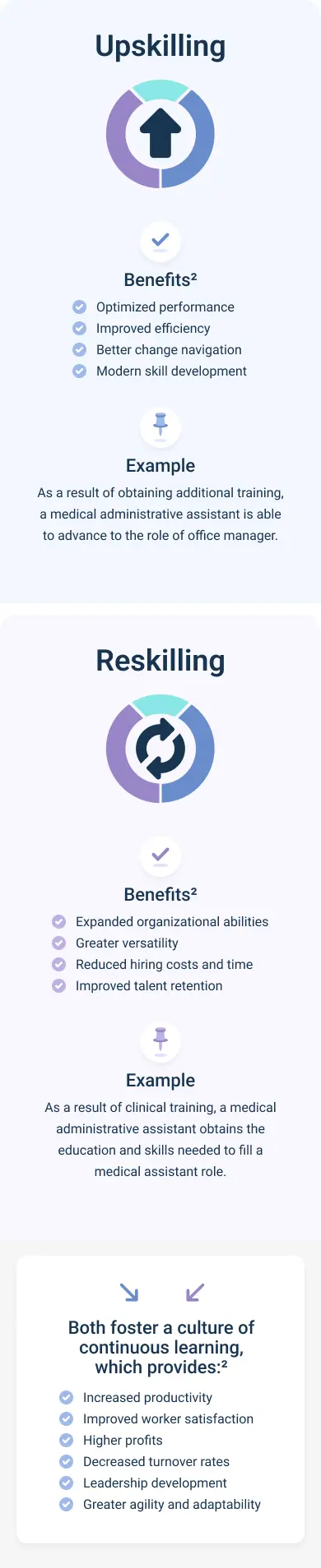
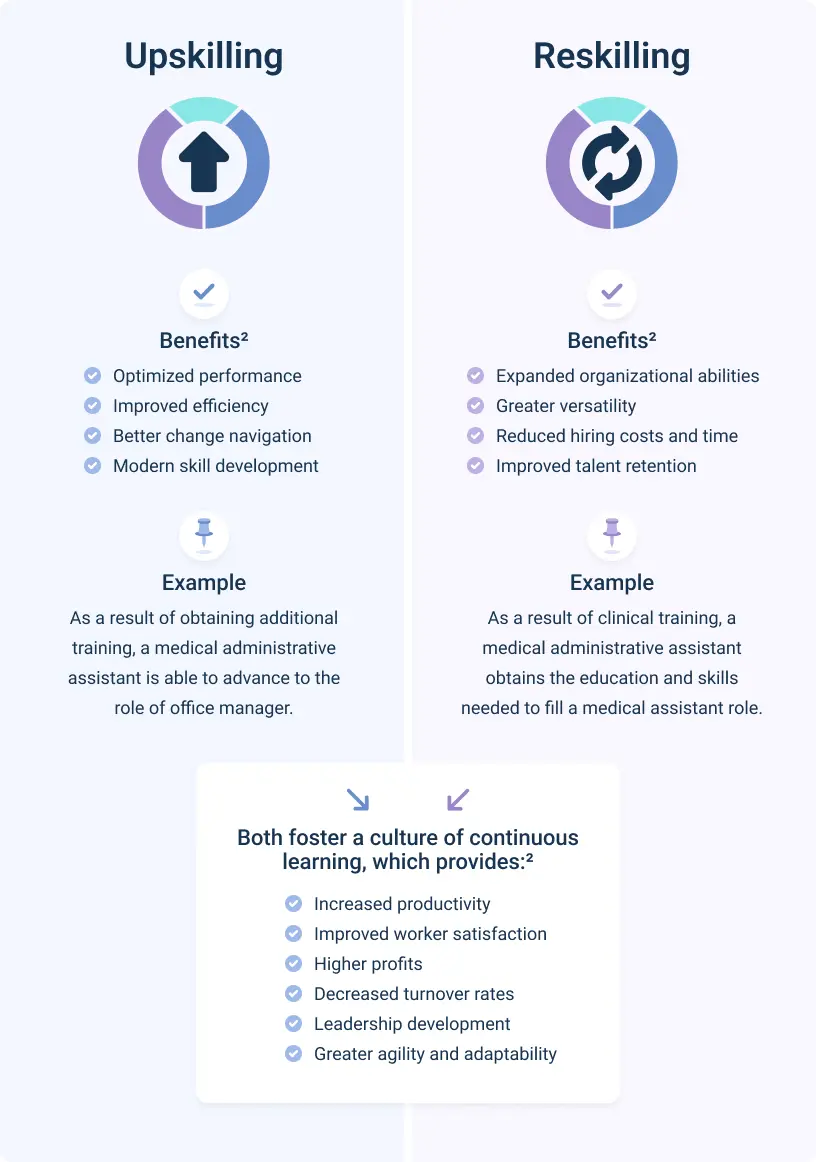
Develop a continuous learning culture
Healthcare workers must stay updated on the latest advancements in the healthcare field, which can involve learning how to effectively apply or utilize new processes, procedures, and technology. Creating a continuous learning culture can help your organization and team stay in pace with, or even ahead of, these advances.
Cross-train team members for multiple healthcare roles
In some cases, the quickest way to fill an open slot may be to prepare an employee in a different position to fill that role. Reskilling can help create cross-functional teams, where multiskilled workers are able to help fill vacancies in other open roles at a moment’s notice.
Helpful Tip: Identify positions within your team that are facing worker shortages but could potentially be filled through reskilling efforts. If you’re unsure, your training partner can help determine which cross-training programs could potentially provide the greatest benefit based on your situation and needs.
Invest in future leaders
Talk with your staff and ask what they want to achieve in their healthcare careers. Consider offering them access to training for higher-level positions they’re interested in. This enables your team members to follow the career path they desire while potentially inspiring loyalty to your organization.
Why Choose Nasium Training’s Healthcare Workforce Upskilling and Reskilling Programs?
Nasium Training specializes in upskilling, reskilling, and cross-skilling courses for healthcare professionals in both clinical and non-clinical roles. Our programs can be tailored to meet your organization’s training needs and goals.
We’re also a member of the Vocate Education Solutions (Vocate) system. Together, the Vocate system of organizations brings more than 130 years of combined expertise across education, career development, and continuing medical education. This collective experience strengthens Nasium Training’s ability to support employers with impactful, flexible training solutions built to meet today’s workforce needs and prepare teams for what’s next.
It can be hard enough to be a CNO. Let us help you reduce some of the stress by creating training programs designed to resolve some of your most significant staffing challenges. Contact us to discuss your options.
Frequently Asked Questions about Upskilling and Reskilling for Healthcare
Why should CNOs invest in upskilling and reskilling?
Upskilling and reskilling programs can help healthcare organizations improve retention, reduce hiring costs, increase innovation, and develop stronger branding.1 At Nasium Training, we want to help our employer partners achieve results that matter. You decide which workforce metrics are important to you, and then we work together to create a tailored training program that helps address those goals.
What factors should CNOs consider when selecting training?
CNOs may want to consider whether a particular training offers a patient-centric approach, if programs can be tailored, the delivery model, employee time commitment, feedback mechanisms, and the return on investment. Evaluating these factors can help healthcare organizations choose training solutions that align with their workforce needs and goals.
What is the ROI of healthcare training?
The return on investment (ROI) of healthcare training can be assessed by looking at metrics such as employee attraction and retention rates, productivity output, worker and/or patient satisfaction levels, and operational costs. Measuring these outcomes can help healthcare organizations evaluate the long-term value of workforce training investments.
Get solutions for your healthcare workforce challenges.
We understand the working learner. Talk to us and we can customize
our healthcare training components to deliver the trained workforce
you need.
About the Author
Christina DeBusk is a freelance writer who has been providing health and wellness content to healthcare organizations such as the American Chiropractic Association and International Sports Sciences Association (ISSA) since 2011. She obtained her Bachelor of Science in Sociology from Central Michigan University, minoring in psychology. She has also earned several ISSA certifications, including Certified Personal Trainer and Certified Nutrition Specialist, achieving the status of Elite Trainer.
Get solutions for your healthcare workforce challenges.
We understand the working learner. Talk to us and we can customize our
healthcare training components to deliver the trained workforce you need.