Key Insights:
- At Nasium Training, we believe that results matter — for patients, healthcare teams, and entire organizations. We also feel that an employee training strategy should help our employer partners with retention, competitiveness, hiring costs, and other labor challenges.
- Our healthcare workforce training approach offers employees the flexibility to continue working while advancing their skills. We provide support to nurture their professional success, such as by helping them prepare for industry certification exams.1
- Nasium Training’s online and in-person instructor-led delivery and training programs include personalized learner feedback and utilize formats that have been linked to improved knowledge retention and practical reinforcement.
A patient’s journey begins with hope. Behind every test, treatment, and follow-up is the desire that the care they receive will lead to feeling better and improving their health. To them, results represent progress and peace of mind. They serve as an indicator that their health is moving in a positive direction.
Providing for patients begins before diagnosis and treatment. It starts with ensuring that your staff is properly trained via healthcare employee training programs tailored to your organization’s unique workforce challenges, skills gaps, and goals.
Workforce Skills Development: The Foundation of Results
When organizations implement training strategies that provide employees with the tools needed for success in their healthcare roles, everyone wins. Healthcare professionals can perform their duties effectively and efficiently, supporting team and departmental productivity. Patients gain access to care that utilizes current techniques and meets modern-day industry standards.
Organizations can also benefit because developing a solid training program can aid in:2
- Improved employee retention
- Lower hiring costs
- Greater adaptability and competitiveness
- Increased innovation
- Stronger employer branding
This type of strategy includes the utilization of learning approaches that give employees access to the information, experts, and resources that not only help keep them informed but also foster engagement. This is Nasium Training’s approach.
Healthcare Employee Training Focused on Flexibility and Support
At Nasium Training, we believe that healthcare employee training should be flexible enough to be accessible to working learners. It should also provide the support these allied health professionals need to build the skills required for a long, successful career, within this growing field,3 and also — more specifically — within your organization.
To achieve this, we have devised a unique training approach, which provides employees with:
- Wraparound support services: Nasium Training offers employees academic guidance, including tutoring, if needed. This helps ensure that they understand the information provided and can apply proper techniques in workplace settings.
- Certification prep: Certification can elevate patient care, increase professional credibility, and enhance employees’ career advancement opportunities.4 Many of our healthcare training programs prepare workers for these credentialing exams.1
- Training flexibility: Employees can’t drop everything to engage in training. They need options that enable them to maintain their home and work obligations while building new skills. Nasium Training courses are often available entirely online or via a hybrid format.
Learning Formats to Support Results-Based Goals
Healthcare employee training can be provided using various formats. Nasium Training utilizes both instructor-led delivery and hybrid training programs to help our employer partners achieve their desired goals and results.
The value of instructor-led training
Instructor-led training offers employees the ability to actively participate in the learning process. They’re able to immediately ask questions about topics or concepts they don’t understand, while gaining real-time, personalized feedback.5 This can help keep them engaged as they gain new knowledge and skills.
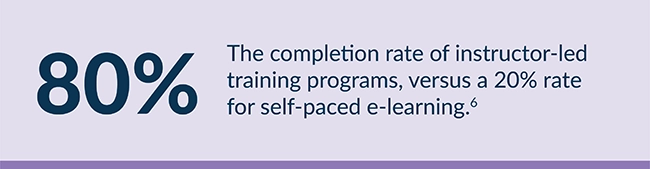
Instructor-led training can also be beneficial for learners who struggle with self-paced formats. The instructor sets the tempo of the course, helping learners stay motivated and on track.
Organizational benefits of a hybrid approach
Utilizing learning formats that combine online instruction and in-person clinical practice can provide organizations with a variety of benefits:7
- Increased employee engagement and focus
- Improved knowledge retention and practical reinforcement
- Reduced travel and venue costs, maximizing your training budget
- Greater availability to employees across multiple locations
- Data to track learner progress and identify knowledge gaps
Passive online courses might check a compliance box, but they may not build the skills, confidence, and teamwork that drive real progress. Hybrid and instructor-led learning blends knowledge, practice, interaction, and feedback into training that educates and empowers.
The National Healthcareer Association’s (NHA’s) pass rate for the Certified Clinical Medical Assistant (CCMA) certification exam in 2024 was 81.30%.8 The pass rate for Nasium Training learners who completed the CCMA in 2024 was 87%.9
How Are You Driving Results That Matter?
Results matter — and so does how you achieve them. This involves utilizing a strategy that provides:
- Online foundational content that employees can access on their schedule
- Instructor-led sessions that encourage participation, feedback, and real-time problem solving
- Team-based learning experiences that strengthen competency and collaboration
- In-person clinical practice to promote skill development
An effective healthcare workforce training solution is about integrating engagement, practice, and teamwork to build confidence that transfers to real clinical environments. Nasium Training anchors our programs on the outcomes your patients and your organization prioritize, from improved clinical decision-making to more consistent performance in day-to-day care delivery.
Contact us to discuss our healthcare workforce solutions and how they can be tailored to support the results you care about most.
1 Learners must meet eligibility criteria to sit for applicable certification exams.
2 Hastwell, C. Employee Training and Development: The Benefits of Upskilling or Reskilling Your Team. Great Place to Work, The benefits of training and development for organizations. https://www.greatplacetowork.com/resources/blog/employee-training-development-benefits-planning
3 Bureau of Labor Statistics. Occupational Outlook Handbook. Healthcare Occupations, para. 2. https://www.bls.gov/ooh/healthcare/home.htm
4 American Medical Technologists. 5 Reasons Certification Can Boost the Careers of Allied Health Grads, nos. 1, 3, and 4. https://americanmedtech.org/blog/blog-post/5-reasons-certification-can-boost-the-careers-of-allied-health-grads
5 Data Society. Live Instructor-Led Training vs. Self-Paced Learning: Why Instructor-Led Training is the Better Option, The Human Connection: Why It Matters, para. 1. https://datasociety.com/live-instructor-led-training-vs-self-paced-learning-why-instructor-led-training-is-the-better-option/
6 eLeap. Instructor-Led Training: Why It Still Matters in the Modern Learning Landscape, para. 1. https://www.eleapsoftware.com/instructor-led-training-why-it-still-matters-in-the-modern-learning-landscape/?utm_source=chatgpt.com
7 Cleary, A. How Blended Learning Enhances Training for a Hybrid Workforce. Neovation, Benefits of blended learning for organizations. https://www.neovation.com/learn/blended-learning-for-a-hybrid-workforce
8 There were 78,681 exams administered. Nasium Training learners are part of the NHA’s average pass rate.
9 Nasium Training’s pass rate included 38 learners, of which 33 passed.