Shaping Change on Mental Health Training: Joint Commission’s New Performance Goals
Article by Julia Bailey
Article by Julia Bailey
As part of its new Accreditation 360 survey approach, Joint Commission
is shifting emphasis toward competency-based education and data-driven skill
development, particularly in areas tied to workforce readiness and patient
safety. This shift is taking formal shape through new National Performance
Goals™ (NPGs). Joint Commission is an independent nonprofit that accredits
healthcare organizations and sets standards for quality and patient safety.
Shining a light on training and competency
On January 1, 2026, Joint Commission announced that its new National
Performance Goals (NPGs) will replace the old National Patient Safety Goals®
(NPSGs),1 moving beyond basic compliance to a focus on actual
patient safety results and integrating regulatory and quality standards into a
clearer framework for hospitals and critical access hospitals.
These new NPGs are organized into 14 measurable topics with clearly defined
goals. They formalize expectations around demonstrated competence,
elevating mental health awareness and workforce readiness as measurable
accreditation priorities. According to Joint Commission, these new
requirements bring “a sharper focus to pressing issues in healthcare,”
including mental health awareness, trauma-informed approaches, and
compassionate communication.2
Training programs that address these areas will now support both accreditation
goals and workforce sustainability.
The move from prescriptive requirements to NPGs signals that healthcare
organizations will need to change their perspective from whether their staff
has completed training to how staff perform, especially in high-risk
areas like behavioral health and suicide risk. Workforce development programs
must become part of the organization’s patient safety strategy by supporting
real-world decision-making, not just knowledge, and by ensuring that the
training is reinforced over time.
“The new NPGs demonstrate that healthcare systems will need to prioritize
mental health for patients and team members. We are proud to offer a program
that equips organizations with the tools and training to better support their
workforce and ultimately improve patient care,” says April Neumann, executive
vice president of Workforce Transformation at Vocate Education Solutions.
“Hearing the positive feedback so far has been very meaningful.”
“We are proud to offer a program that equips organizations with the tools
and training to better support their workforce and ultimately improve
patient care.”
- April Neumann, EVP of Workforce Transformation, Vocate
Education Solutions.
How Nasium Training supports compliance with NPGs
Nasium Training partners with hospitals and other healthcare organizations to
offer solutions for workforce development and retention that focus on flexible
learning paths. When it comes to complying with new Joint Commission
expectations, Nasium Training can support healthcare organizations by helping
staff demonstrate competence in key mental health-related areas.
Nasium Training offers a
Mental Health Foundations for Healthcare Professionals
that combines evidence-based content with applied learning that mirrors real
clinical environments. According to Etta Rahming, one of Nasium Training’s
training specialists, the course helps learners articulate and strengthen
skills they may already be using instinctively, while also sharpening their
ability to apply those skills consistently. “The course helps them sharpen
their skills and it highlights what they already know, but don’t have the
words for,” Rahming explains. “They learn how to recognize risk earlier and
how to respond more clearly and effectively.”
The eight-week course is built around realistic scenarios, guided discussion,
and live simulations, with learners working through situations involving
suicide risk, abuse, de-escalation, and trauma-informed communication. They
often work in small groups, then reconvene to compare approaches and outcomes.
“It isn’t just teaching,” Rahming says. “They actually do the work. They
developed plans for how to handle situations, and a self-care plan they can
take with them after the course.”
“It isn’t just teaching. They actually do the work.”
- Etta Rahming
Former instructor Elizabeth Minton notes that this applied approach is
particularly important for healthcare professionals who interact closely with
patients, but who may not have had formal mental health training. “Many of the
learners are medical assistants or aides, people who interface with patients
every day,” Minton says. “The course helps them recognize when behavior might
signal something deeper, rather than just assuming anger or noncompliance.”
The curriculum incorporates vignettes, video simulations, and role play that
demonstrate how mental health conditions can evolve over time. This helps
learners identify visual, verbal, and behavioral cues that may indicate
escalating risk. “The students learn to look beyond what someone is saying to
how they’re presenting, how that presentation changes, and what those changes
might mean,” Rahming explains.
Just as important, the Nasium Training course addresses the mental health of
healthcare workers themselves. Instructors emphasize boundary setting,
self-awareness, and strategies for managing emotional fatigue, a growing
concern as burnout continues to affect safety, retention, and quality of care.
“If you want your workers to last, you have to help them take care of
themselves,” Rahming says. “That’s not always emphasized, but it should be.”
By combining structured content with hands-on application, the Mental Health
Foundations course helps healthcare organizations move closer to what Joint
Commission now expects: staff who can demonstrate how they apply mental health
awareness and risk recognition in real situations, not just document that
training occurred.
The course aligns with the new Joint Commission requirements by:
Building awareness and identification skills
Enhancing response competence
Fostering trauma-informed, compassionate care
Supporting professional responsibilities and reporting
Promoting staff resilience and self-care
When a healthcare organization prepares for a Joint Commission survey or daily
operations, they need to know if their staff can demonstrate competency in
applying those practices in real interactions. Training like the Mental Health
Foundations course can support organizations as they work to meet Joint
Commission expectations around mental health awareness and risk reduction.
These applied training elements directly support the mental health priorities
now embedded in Joint Commission’s National Performance Goals.
NPGs that focus on mental health issues
Today, the need for skills and competencies to address patients with mental
health risks extends across a range of healthcare settings, including
emergency departments, med-surg units, outpatient settings, and transitions of
care. According to the CDC, for example, as of November 2025, 5,123 out of
every 100,000 ED visits were mental health related.3
Among the new goals, two stand out for their direct relevance to mental health
safety and workforce well-being.
NPG 8 is a direct mental health safety measure designed to
support improving mental health awareness to help prevent harm in vulnerable
patients. It supports mental health awareness by requiring:
mental health screening as a routine part of the care process
comprehensive assessment and mitigation
policies and procedures for care of at-risk patients
procedures for follow-up care4
Importantly, NPG 8 applies across care settings, not only in behavioral health
environments. This new goal is designed to ensure that healthcare
organizations make the identification and management of suicide risk a
high-priority and measurable topic. Joint Commission considers training in
suicide risk prevention to be essential, to ensure that healthcare providers
can conduct thorough assessments and implement appropriate evidence-based
interventions to reduce harm and manage risk effectively.
“Hospital suicide-risk policies should include training and competence
assessment for staff caring for patients at risk.”
- Joint Commission
Joint Commission recognizes that burnout and mental health issues also pose
critical safety challenges for healthcare staff. The new NPGs encourage
leadership to create supportive environments with interventions like
mindfulness training, measuring well-being, and involving staff in decision
making to combat factors that drive burnout.
NPG 12 focuses on Health Professional Resource Management. It
links staffing to patient safety and quality by requiring hospitals to have
the right staffing mix, adequate coverage, and manageable workloads. The focus
is root cause, tackling understaffing, poor team design, and excessive
administrative loads to reduce stress and other factors contributing to
burnout. Workforce development programs play a critical role in supporting NPG
12 by helping staff build resilience, communication skills, and coping
strategies that mitigate burnout even when operational pressures persist.5
These new NPGs elevate the importance of mental health safety beyond minimum
regulations and align with the Centers for Medicare & Medicaid Services (CMS)
requirements.6
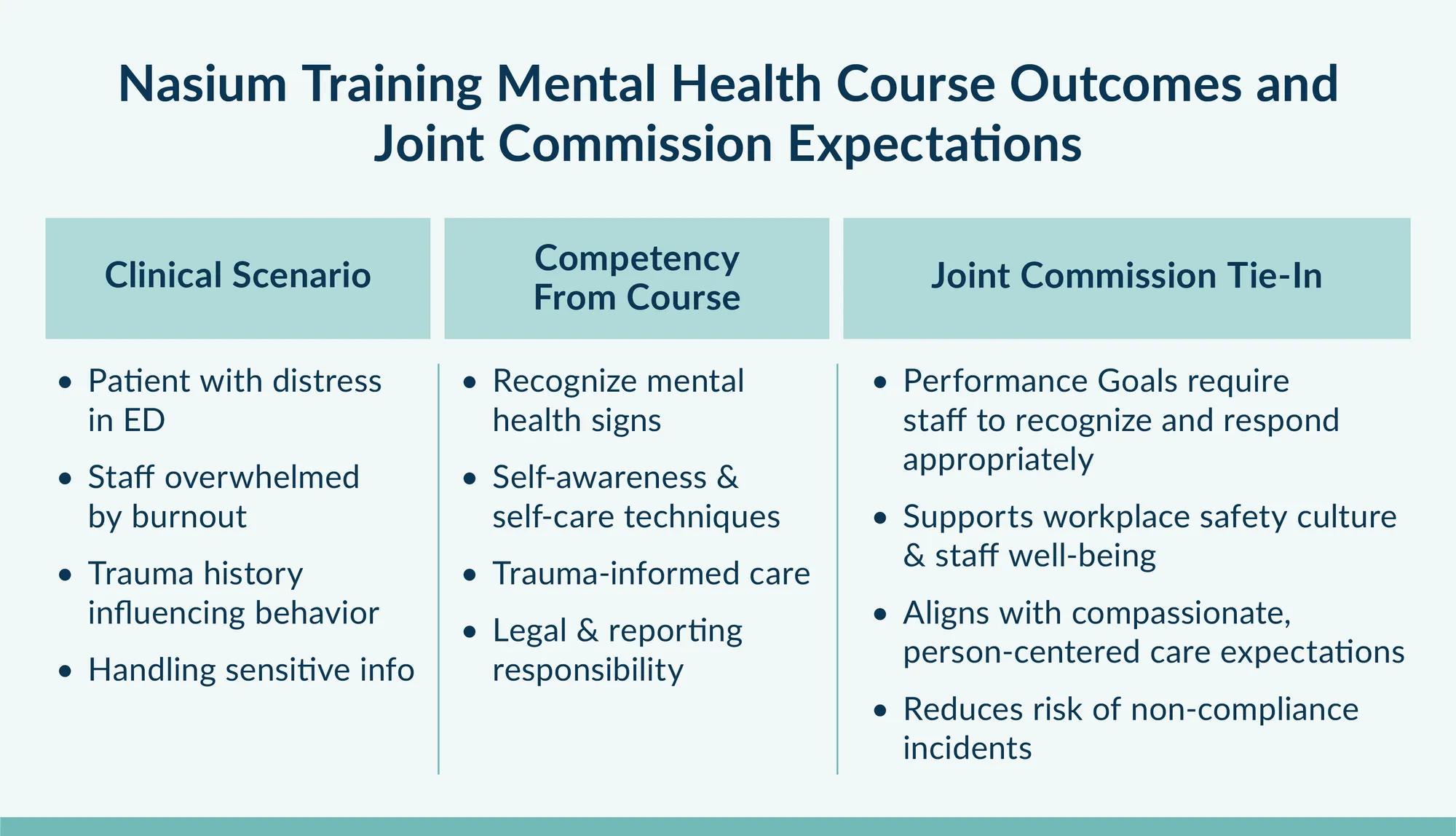
The table below illustrates how common healthcare scenarios map directly to
competencies developed in the Mental Health Foundations course — and to Joint
Commission Performance Goal expectations. See how each course element solves a
specific care or safety scenario.
Nasium Training goes beyond generic training. The eight-week duration and
depth of the course is more extensive than the more common one-off module. It
includes applied scenarios and assessment, with focus on both patient-facing
and staff-facing competence.
Contact us to learn more about the Nasium Training mental
health training program or to discuss how we can help you customize it to meet
the needs of your workforce.
Get solutions for your healthcare workforce challenges.
We understand the working learner. Talk to us and we can customize
our healthcare training components to deliver the trained workforce
you need.
About the Author
Julia Bailey is a freelance healthcare and B2B content developer who creates thought leadership and marketing content for healthcare organizations, associations, publishers, and educators. Her work includes editorial for hospital publications, blogs for healthcare service providers, and campaigns for healthcare membership organizations, with a focus on workforce development, patient care, and healthcare trends.
Get solutions for your healthcare workforce challenges.
We understand the working learner. Talk to us and we can customize our
healthcare training components to deliver the trained workforce you need.